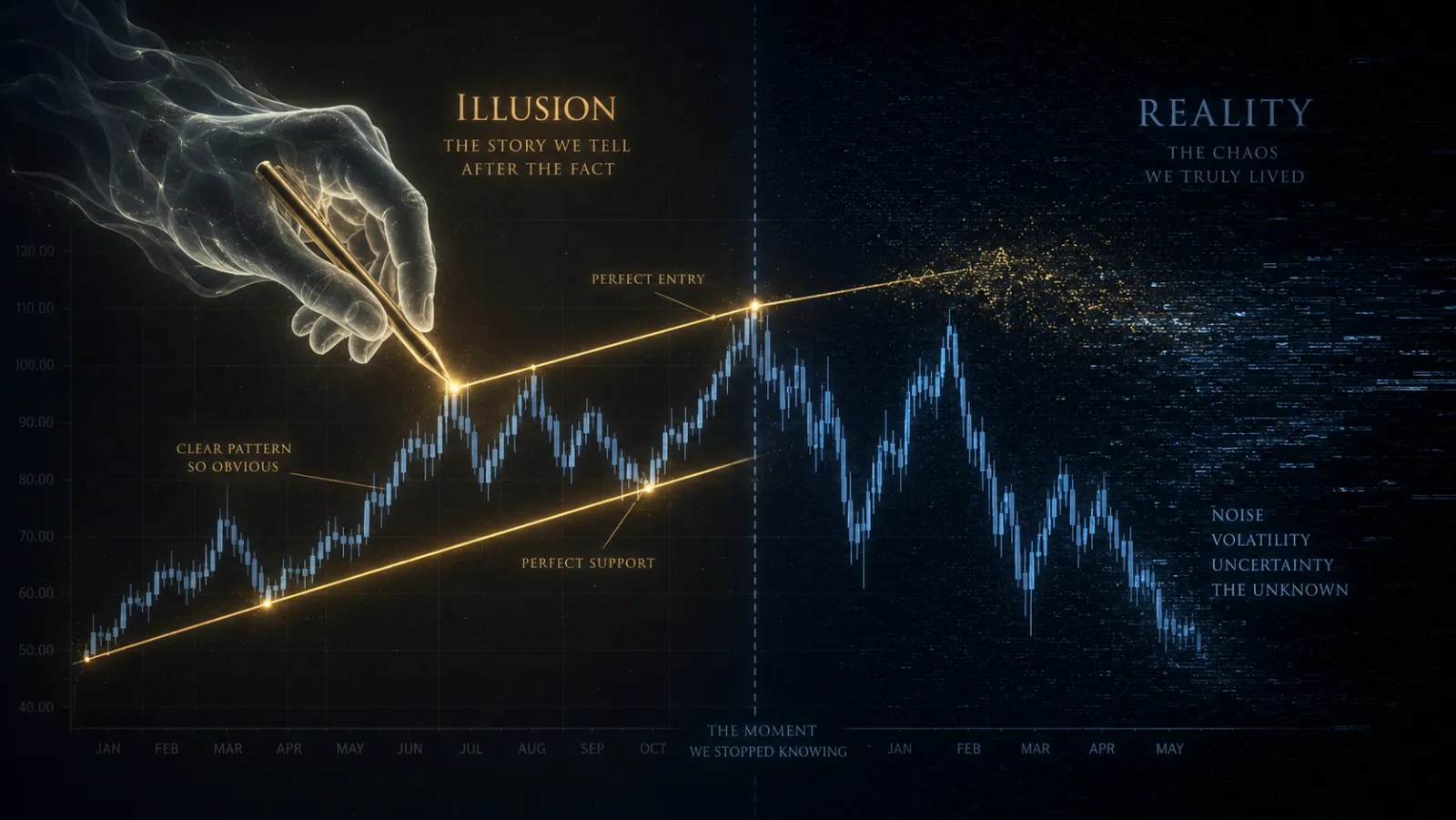
💡 Em uma frase
O que realmente separa o sinal do ruído não é "ler o gráfico depois que tudo aconteceu", mas sim uma regra que existia de antemão e que pode ser falsificada. Um gráfico antigo coberto de linhas de previsão perfeitas parece impecável, mas não vale nada para a sua próxima operação.
Você com certeza já viu esse tipo de captura de tela: um gráfico de preços densamente coberto de linhas, setas apontando com precisão para cada topo e cada fundo, com a legenda "eu avisei desse repique lá atrás". Parece impecável. Mas não vale nada para a sua próxima operação. Este artigo quer deixar uma coisa clara — o que verdadeiramente separa o sinal do ruído é uma regra que existia de antemão e que pode ser falsificada.
1. O que é o "traçado de linhas em retrospecto"?
O defeito fatal do traçado de linhas em retrospecto nunca foi "olhar o gráfico depois do fato" — por definição, toda revisão acontece depois do fato. O seu defeito fatal é este:
Usar um conjunto elástico de regras para parecer certo em toda e qualquer situação, sem produzir absolutamente nenhuma vantagem executável para o futuro.
Depois que o movimento termina, você pode traçar linhas sobre ele do jeito que quiser e todas elas "encaixam". O objetivo desse espetáculo é provar o quanto você é inteligente, e não testar uma regra que existia de antemão. Os dois parecem "revisão", mas, na essência, são opostos. Ele tem três sinais reveladores que você consegue identificar todas as vezes:
① A regra é elástica
O mesmo padrão é um "rompimento confirmado" quando sobe e uma "armadilha para os comprados (bull trap)" quando cai. A regra é sempre ajustada depois do fato para se encaixar no movimento — ela não pode ser falsificada e, portanto, não pode ser reproduzida no futuro.
② Nunca define uma condição de invalidação
Uma previsão genuína diz "se romper abaixo de X, eu estou errado". Uma previsão de espetáculo diz apenas "vai subir / vai cair" — nunca existe uma condição sob a qual ela poderia ser provada errada.
③ Só mostra os acertos
Três acertos perfeitos são narrados em rico detalhe, enquanto as operações perdedoras e as previsões erradas somem silenciosamente. Esta é a forma mais comum de viés de sobrevivência.
Sempre que uma análise cumprir os três critérios ao mesmo tempo — por mais bonito que seja o gráfico ou por mais convincente que seja a lábia — trate-a como entretenimento, não como evidência.
2. Por que o cérebro humano adora traçar linhas
Entender isso ajuda você a ser mais honesto consigo mesmo — porque tanto você quanto eu fazemos isso. Não é uma falha moral; é uma configuração cognitiva padrão.
- Viés de sobrevivência: só vemos as capturas de tela do "eu acertei", porque quem errou nunca posta uma captura. A amostra que sobrevive é enviesada para o sucesso, o que nos faz superestimar o quão confiável a "previsão por leitura de gráfico" realmente é.
- Polimento da memória: assim que o movimento termina, o cérebro reescreve silenciosamente o que você de fato pensou na hora — "eu sabia que ia ser assim". Essa onisciência retrospectiva contamina a sua lembrança daquilo em que você genuinamente acreditava no momento.
- Impulso narrativo: o cérebro odeia a aleatoriedade e adora histórias de causa e efeito. Um roteiro sobre "as baleias sacudindo as mãos fracas e depois pumpando" parece muito mais confortável do que "aquele trecho foi só ruído aleatório e eu não entendi" — ainda que a segunda versão seja a verdade.
3. Três níveis de uma revisão bem-feita: do básico ao avançado
O propósito da revisão não é provar que você é inteligente, mas testar uma regra que existia de antemão e produzir uma conclusão que aprimore o sistema. As três abordagens a seguir vão de menor a maior esforço, e cada uma elimina um pouco mais da liberdade de "traçar do jeito que quiser".
Nível 1 · Revisão com âncora fixa (eliminando a subjetividade dos parâmetros)
Antes de revisar, trave suas ferramentas e parâmetros e nunca os altere no meio do caminho. Por exemplo: POC/VAH/VAL do perfil de volume (volume profile) com base em uma janela fixa móvel (digamos, os últimos 30 dias), médias móveis restritas a 20/50/200 e cruzamentos dourado e da morte (golden/death cross) totalmente mecânicos.
Por que isso importa: quando os parâmetros não podem ser "ajustados depois do fato para se encaixar no movimento", o seu traçado de linhas deixa de ser um espetáculo subjetivo e passa a ser uma medição objetiva — e só então a conclusão pode ser reproduzida no futuro.
Nível 2 · Diário de pontos de decisão (recusando o polimento da memória)
No momento em que o movimento está acontecendo, escreva três frases e registre o horário delas: ① o que eu observo, ② o que eu acho que provavelmente vai acontecer em seguida, ③ o que provaria que eu estou errado. Ao revisar, compare o registro original com o que de fato aconteceu e responda com honestidade — certo ou errado, palpite de sorte ou regra que funciona.
O cerne: coloque o seu eu passado, falho e incompleto, contra o seu eu presente, onisciente em retrospecto. (Detalhamento completo: diário de pontos de decisão)
Nível 3 · Ciclo antecipado de "previsão–verificação" (matando o viés de sobrevivência)
① Publique uma previsão antecipada com prazo definido ("nas próximas X horas, se A acontecer, então B é provável; um rompimento abaixo de C invalida a previsão"), ② quando o prazo se esgotar, confira publicamente o resultado contra as suas palavras originais, esteja você certo ou errado, ③ se estiver errado, analise onde e como ajustar a regra — em vez de arrumar desculpas ou apagar o post silenciosamente.
Por esse critério, qualquer revisão que "só mostra o gráfico antigo vencedor, nunca menciona as perdas e não define nenhuma condição de invalidação" pode ser arquivada diretamente como traçado de linhas em retrospecto.
4. Um filtro universal: 5 critérios para avaliar qualquer conteúdo de trading
Toda opinião de mercado e todo influenciador por quem você passa pode ser submetido aos 5 critérios abaixo. Se atingir um, vale a pena assistir; se não atingir nenhum, passe direto.
- 1. Fornece uma regra "se–então" falsificável. Condições claras de entrada / stop / dimensionamento / filtro, mesmo que aproximadas. Exemplo: "se o candle diário fechar acima da MA 20 e o candle anterior for um padrão de engolfo, entre a preço de mercado na abertura do dia seguinte, com stop na mínima do padrão".
- 2. Mostra "resultados de backtest", não operações isoladas. "Testei esta ideia: PF=1,2, drawdown máximo de 15%, taxa de acerto de 42%" — em vez de escolher a dedo 3 operações perfeitas e chamar isso de "caçada". (Veja backtest > 3 operações perfeitas)
- 3. Publica um registro completo, real/simulado (incluindo as perdas). Um registro contínuo e verificável é o filtro definitivo que separa o sinal do ruído. Sem ele, até a análise mais bonita não passa de entretenimento.
- 4. Foca na "microestrutura de mercado / comportamento dos dados", não em "prever a direção". Desequilíbrio no livro de ofertas, volatilidade em torno do vencimento de opções, estatísticas de continuação após taxas de financiamento (funding) extremas — isso te dá os blocos de construção para montar uma estratégia.
- 5. Ensina você a "como fazer o backtest dessa ideia". A despedida mais honesta é "esta é uma das minhas observações; aqui estão as fontes de dados e as ferramentas que você pode usar para verificá-la", em vez de mandar você fazer copy trade ou comprar um curso.
5. Evolução de mentalidade: da "caça ao santo graal" à "mina de conceitos"
A esta altura, você já superou de fato a fase de "depender de outra pessoa para te entregar uma estratégia pronta". O que mais te ajuda já não é "o quão genial é este influenciador", mas sim tratar qualquer conteúdo como uma fonte de conceitos potencialmente testáveis.
- Você passa por "se o volume dispara perto do POC mas não se sustenta, o preço continua caindo" → extraia isso como um conceito definível → jogue na fila de testes.
- Mesmo que um vídeo seja 90% ruído, extrair apenas 1 conceito que possa ser definido e testado em backtest já significa que você saiu no lucro.
Dessa forma, você fica para sempre em uma posição imbatível: todo conteúdo é apenas a sua "mina de conceitos", julgado no fim das contas pelo seu sistema de backtest, e não o contrário, sem que ninguém consiga te levar pelo nariz. Use o checklist como o seu filtro e o backtest como o seu tribunal. (Método completo: garimpando conteúdo em conceitos testáveis)
6. O fim último da disciplina é entregar as regras a um sistema para executá-las
A lógica se fecha aqui. Se você concorda que:
- uma previsão eficaz precisa ser uma regra falsificável, não traçado de linhas em retrospecto;
- uma regra precisa passar pelo backtest e, depois, ser validada em operação real (real ≠ backtest);
- a evidência mais persuasiva é um registro público contínuo e verificável de forma independente — e você precisa estar disposto a mostrar perdas e drawdowns.
Então você vai perceber que a parte mais difícil da disciplina não é escrever as regras — é executá-las 24/7 sem emoção. As pessoas se cansam, ficam gananciosas, hesitam quando deveriam cortar a perda e se enganam nos próprios diários. É exatamente por isso que a execução sistemática existe, e é o mesmo padrão que exigimos de nós mesmos ao construir a CoinTech2u (o sistema de trading com IA dinâmica multiestratégia):
Operação real falsificável e verificável
O /live-proof lê a API oficial do sistema diretamente a cada hora, apresentando dados operacionais reais e contínuos que qualquer pessoa pode conferir — e não um conjunto selecionado de 3 operações perfeitas. Isto é o critério 3 da Parte 4 ("um registro público") colocado em prática. Para a consolidação anual desse registro contínuo, veja o relatório de desempenho real em 300 contas reais.
Uma metodologia de avaliação pública
As regras de pontuação, as 5 condições de Reprovação Automática (Auto-Fail) e os conflitos de interesse estão todos escritos em /methodology, para que qualquer pessoa possa usar a mesma régua para avaliar de forma independente tanto a nós quanto outros produtos. "Falsificável" também vale para nós.
Sem custódia — os fundos nunca saem da corretora
A estratégia é executada, mas os seus fundos ficam sempre na sua própria conta na Binance / OKX / Bybit / Bitget, com permissões de API minimizadas e sem direito de saque. Você pode entregar as regras a um sistema; não precisa entregar a sua carteira.
Pague pelos resultados
A participação nos lucros só é cobrada quando uma posição é fechada no lucro — o que, por si só, é um compromisso de "deixar o registro falar", e não um compromisso feito com discurso de marketing. Por que a participação nos lucros alinha melhor os dois lados do que uma assinatura? O artigo Participação nos lucros vs assinatura faz as contas faixa por faixa.
Em outras palavras, os mesmos 5 filtros que este artigo ensinou você a usar para avaliar os outros — queremos que você os volte, sem mudar nada, contra nós. Só algo que sobrevive ao próprio padrão tem o direito de falar sobre transparência.
Use o padrão deste artigo para nos julgar
Vencer o "traçado de linhas em retrospecto" não exige um gráfico mais inteligente — apenas um hábito: escreva primeiro uma regra falsificável e depois julgue-a com registros e backtests — inclusive julgando a CoinTech2u.
📚 Leitura complementar (esta série)
Entender a teoria é a parte fácil
Até um método sólido desmorona na execução manual — hesitação, stops deslocados, operações por impulso. O sistema de IA multiestratégia da CoinTech2u executa as regras por você, sem emoção.
Criar conta gratuita